The Diamond Analysis Report

Features

Identification
DIAMOND

Identification

Identification refers to the nature of the stone analysed.

Treatment
N - No indication of treatment

Treatment

The research and identification of the treatment will be carried out for all the stones using all the state-of-the-art equipment and expertise of the Laboratoire Français de Gemmologie.
Our nomenclature is based on the recommendations of recognised international bodies such as the LMHC and the CIBJO, as well as on Decree No. 2002-65 of 14 January 2002, which governs the trade in gemstones and pearls in France.

A diamond showing no treatment will be identified as ‘Diamond’ and the information ‘No indication of treatment’ will be noted on the report.
If a diamond has one of the treatments listed below, it will be identified as a ‘Treated Diamond’ and the nature of the treatment will be noted on the report.

Nomenclature of diamond treatments :

  • G - Graphitisation
  • R - Irradiation
  • R+TE - Irradiation followed by heat treatment
  • HPHT - High pressure, high temperature
  • LD - Laser drilling
  • F(M) - Filling with glass enriched with heavy metals
  • CG - Coating

For all these treatments, except laser drilling, LFG will not gradate the stone.
Shape – Cut
Round – Brillant

Shape – Cut

The shape, cut and dimensions (obtained with the Sarine Diamension HD digital measuring instrument) describe the external appearance of the stone.

When you deposit a jewel with several stones, or batches, we indicate the diametrical variation of the batch.

Measurements
9.55 - 9.69 x 5.71 mm
Mass
3.10 ct

Mass

The weight of the stones is indicated in carats (1ct = 0.2 g) to two decimal places.

Rounding is done according to the 3rd decimal place: if it is less than 9 then no rounding, if it is equal to 9 then round up. For example: 0.9990 ct is 1.00 carat but 0.9989 ct is 0.99 carat.

If the jewel is set with stones, it is weighed in grams.

Colour
D

Colour

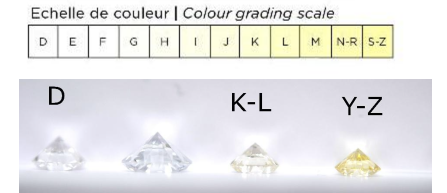
The colour of a colourless diamond is established by comparison with our diamond masterstone set. The latter has been established in comparison with the CIBJO masterstone set. (https://cibjo.org/wp-content/uploads/2022/10/CIBJO-Diamond-Blue-Book-2022-1.pdf).
The rating corresponds to the following scale, which you will find on your reports:

For coloured diamonds, the LFG uses commercially accepted terms to qualify the colour of these diamonds according to the following scale:

  • Faint
  • « Fancy » light
  • « Fancy »
  • « Fancy » intense
  • « Fancy » vivid
  • « Fancy » dark
  • « Fancy » deep

The colour described is the main shade with secondary shades.
Ex: ‘Fancy’ vivid pink, slightly purple

Clarity
VS1

Clarity

The internal inclusions and surface defects present in a stone determine its purity.

The grading nomenclature used at the LFG corresponds to the CIBJO recommendations (https://cibjo.org/wp-content/uploads/2022/10/CIBJO-Diamond-Blue-Book-2022-1.pdf)

You will find this same scale on your reports:

Cut
Good

Cut

The cut grade is established according to strict standards that combine information on the proportions, symmetry, polish and thickness of the girdle.

It is indicated by one of the following criteria: Excellent - Very good - Good - Average - Fair

Polish
Very Good

Polish

The polish is graded with one of the following criteria: Excellent - Very good - Good - Average - Fair.

These characteristics are taken into account when assessing the grade of the cut.

Symmetry
Good

Symmetry

Symmetry is graded using one of the following criteria: Excellent - Very good - Good - Average - Fair.


This characteristic is taken into account when assessing the cut grade.

Luminescence
None

Luminescence

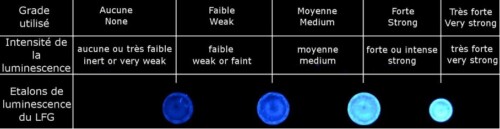
Fluorescence is indicated by one of the following criteria: None - Weak - Medium - Strong - Very strong.

It is graded by comparison with the LFG's fluorescence standards under long UV light (365 nm).

Type
la

Type

The LFG is one of the few gemmological laboratories to specify the type of diamond in its reports using infrared spectrometry:

  • Type Ia: Presence of aggregated nitrogen
  • Type Ib : Presence of isolated nitrogen
  • Type IIa: No nitrogen present
  • Type IIb : No nitrogen present but boron present

Scientific instruments used

In the interest of transparency, the LFG will tell you which scientific instruments have been used to test your stone.

Scientific instruments used

  • Mass measurement
  • Normalised lighting
  • Infrared spectrometer (FTIR)
  • Measurer
  • Ultraviolet lamps
  • Photography device
  • Microscope

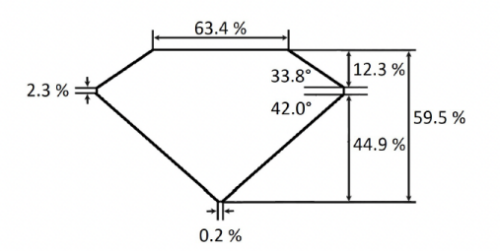
Proportions

Diagram of the stone's proportions obtained with the Sarine Diamension HD digital measurer


Girdle : Very thin to medium, faceted


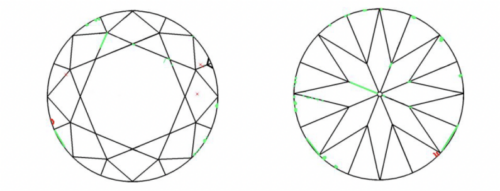
Clarity diagram

Clarity diagram

  • In green: the diamond's external characteristics
  • In red: the diamond's internal characteristics
  • In black: other characteristics (additional facets, engraving, etc.)

Clarity diagrams, table view and culet view, showing the specific characteristics of your stone:


A. Herreweghe, DUG, MSc

A. Delaunay, DUG, MSc