Opal Analysis Report

Features

Page 1 of report

Object

Object

The object specifies whether we have received a single stone, a batch or a jewel, and the type of jewel.

Shape - Cut
Oval - Cabochon

Shape - Cut

The shape, cut and measurements describe the external appearance of the stone. When you deposit a jewel with several stones, or batches, we note the diametrical variation of the batch.

Measurements
18.11 x 14.19 x 8.24 mm

Measurements

The shape, cut and measurements describe the external appearance of the stone. When you deposit a jewel with several stones, or batches, we note the diametrical variation of the batch.

Mass
13.19 ct

Mass

The weight of the stones is indicated in carats (1ct = 0.2 g) to two decimal places.

Rounding is done according to the 3rd decimal place: if it is less than 9 then no rounding, if it is equal to 9 then round up. For example: 0.9990 ct is 1.00 carat but 0.9989 ct is 0.99 carat.

If the jewel is set with stones, it is weighed in grams.

Mass colour
N3

Mass colour

The colour gives an indication of the colour in the mass and the diffraction colours.

Find out more about colour designation

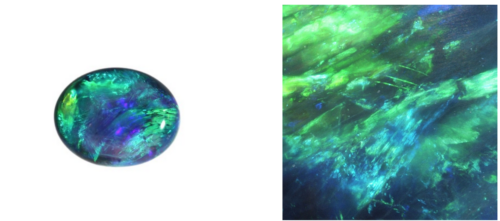
Play of colour
Mainly blue to green

Scientific instruments used

  • Mass measurement
  • Normalised lighting
  • Infrared spectrometer (FTIR)
  • Measurer
  • Ultraviolet lamps
  • Raman spectrometer
  • Photography device
  • Microscope
  • EDXRF Spectrometer

Identification

BLACK OPAL (NATURAL OPAL)


Treatments

N - No indication of treatments


Geographic origin

The geographical origin indicated is an opinion of the Laboratory based on gemmological data (spectra, chemistry, inclusions).

Australia


Photography

The colour and dimensions of the object analysed are approximate.


A. Delaunay, A. Delaunay, DUG, MSc

U. Hennebois, DUG, AG